Humana People to People seeks to inspire and complement public education. We want teachers, students, parents, educational institutions, officials, and Ministries of Education to draw inspiration from co-operation, direct
or indirect, with Humana People to People schools and education projects.
We prioritise teacher training to help reduce the shortage of primary school teachers, especially in rural areas, so every child benefits from a qualified and multi-skilled teacher. Our programmes are designed to allow everyone to explore the reality of life and apply what they learn to influence that reality. They support personal development, promote child-friendly learning environment, and advance community development.
We prioritise vocational training because it prepares youth to face 21st-century issues, connect to real-world challenges, and equip them to be innovative, embrace entrepreneurship, and address community challenges.
We prioritise early childhood development and strive to create safe environments because it is a once-in-a-lifetime window of rapid personal development that underpins all future learning, health, and behaviour.
We include training in various forms across our programmes, including sustainable agriculture, community development, and health programmes.
Humana People to People pedagogy has been developed over 40+ years and is being practised across schools and training programmes, in educational institutions and other teaching and learning projects. It is also being practised in training activities within other thematic areas.
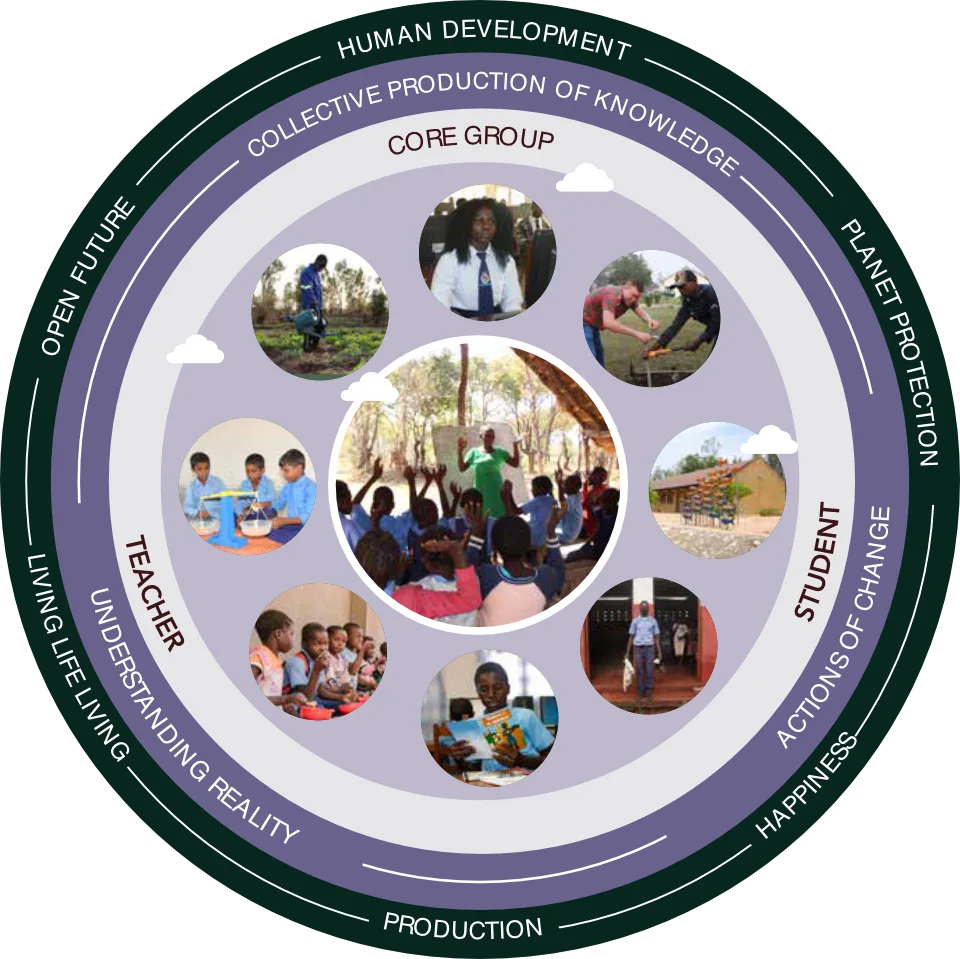
Student | Teacher | Core group
The Humana People to People pedagogy starts with the student as a singularity and gives them the core group. In all our education programmes, students are organised in a collective, in a small group. The teacher is an equal member of the group. Here individual and group goals are discussed, targets set, new knowledge conquered, tears shed, and laughter rolls. It is social, educational, productive and emotional. It is a safe haven for the individual student in times of demands and new challenges, which is an unavoidable and necessary part of growing with one’s education. It is here students and teachers hone their skills in cooperation and co-living.
Knowledge | Understanding | Actions of change
Next comes the trinity of collective production of knowledge, understanding reality and actions of change. Trinity, because it is not one after the other; it is the three of them together. They influence each other. When we produce knowledge, it leads to a better understanding of reality. When we understand reality, it leads to the production of more knowledge. Action of change must always have knowledge and understanding as its foundation – but at the same time, the very action of change deepens our understanding and thirst for more knowledge.
Open future | Living life living | Human development | Happiness | Production | Planet protection
In the outer circle there are indications of areas of life that thrive as a result of the two first circles. The circle format fits well with the content – when writing about it, inevitably one element will be mentioned before the other. But that is not how it works. Human development, production, living life living, planet protection, happiness and open future are all intertwined. This is also how our lives are – they are not in straight lines, not in orderly sequence, but in lively, dynamic and dialectic processes. And like this, education should serve us in our lives.
Teacher Training
Since 1993, Humana People to People has been training teachers to work in public primary schools across 34 Teacher Training Institutions in Africa and 22 Teacher Training Programmes in India. The training applies the Humana People to People pedagogy together with national curricula and lasts between two and three years.
The core group is a fundamental organisational structure within the teacher training programme. It decentralises learning and creates space for the core group students and teachers to interact, debate, challenge existing knowledge, and take up practical actions.
Students are trained to be competent in all subjects that form the national primary school curriculum. They acquire thorough knowledge of the methods of teaching each subject, be it mathematics or physical education, geography or the natural sciences, including the indigenous languages. Additionally, students take part in the operation of the college, with real-life responsibilities. This helps them gain hands-on experience in school management and administration, skills that serve them well in their future profession.
After graduation, teachers can join the Graduate Teachers Network to collaborate and share experiences to better respond to the many daily challenges in their work. They focus on teaching quality and promote campaigns on health, culture, gender, sports, and environmental protection.
Key figures for teacher training
Find out more on the websites of members in the following countries:
Angola, DR Congo, Guinea Bissau, India, Malawi, Mozambique, Namibia, South Africa, Zambia, Zimbabwe
Technical and Vocational Education and Training (TVET) and Skills Development
In 16 Technical and Vocational Education Training (TVET) colleges spread across eight African countries, Humana People to People members have trained 36,000 young people to be part of local communities’ production and development. Both the formal and informal TVET programmes are designed to be practical and provide real-life experience; in this way, the programmes focus on building the right set of skills and promoting entrepreneurship, thereby enabling young people to become agents of development.
By taking a forward-thinking approach, Humana People to People prepares youth for challenges ahead, thus addressing the 21st-century skills gap. It is not sufficient to train the young person to get a job; where there are no jobs, they must be created, and youth can contribute substantially to that when trained to meet the demands.
Courses on offer are in the areas of agriculture, civil construction, engineering, business administration, hospitality and tourism, and community development. All courses are structured to respond to people’s daily life needs and improve people’s lives.
The Humana People to People members engage with their respective governments at all stages of running the TVET schools, from curriculum design, policy consistency, and development of public-private partnerships. Courses are nationally accredited, developed with national government approval.
Key figures for vocational training
Our TVET schools have the capacity to enrol more than 2700 youths annually. Since our first Vocational School started in 1982, over 36,000 young people have been trained to contribute positively to their communities.
Find out more on the websites of members in the following countries:
Angola, Guinea Bissau, Malawi, Mozambique, Namibia, South Africa, Zambia, Zimbabwe
Early Childhood Development (ECD)
The Early Childhood Development Programme was established to provide affordable preschool education, giving children in rural areas a good foundation when starting primary school and later in life. Humana People to People carries out Early Childhood Development programmes through specific training programmes and community-based initiatives, aiming to provide young children the support they need during their early years.
Our approach focuses on practical learning through play, developing enthusiasm, nurturing curiosity and critical thinking from an early age. By working closely with parents, caregivers, and local communities, we support people in creating inclusive and supportive learning environments that give children, regardless of their background, the opportunity to thrive.
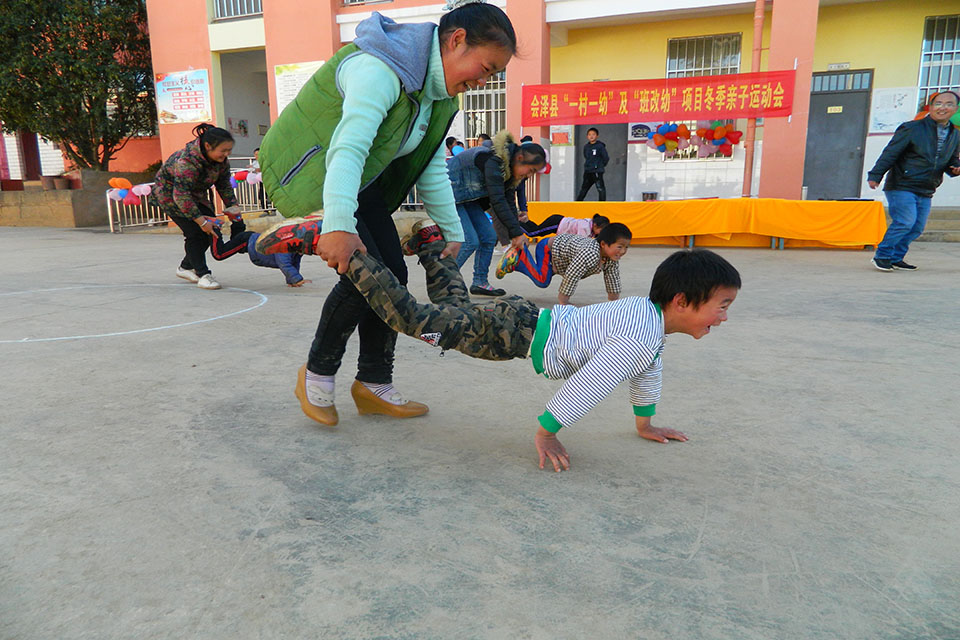
Committees and parents support the teachers in running the ECD centres. Parents participate in training sessions and events, such as “Children’s Day,” as well as classroom improvement actions.
Find out more on the websites of members in the following countries:
China, Namibia, South Africa